SpaceX completes $60bn acquisition of Cursor (Anysphere, Inc.)
Hussain Jeddy · 15 August 2026
Share on LinkedInOn August 14 2026, SpaceX completed its all-stock acquisition of Anysphere, Inc., the AI coding assistant company known as Cursor, at an implied Cursor equity value of $60bn. The deal was originally signed on June 16, and was finally closed yesterday as confirmed by SpaceX's own SEC Form 8-K filed yesterday morning.
Anysphere Inc. builds an AI-powered code editor and coding assistant, and was previously venture-backed (A company that has raised investment from venture-capital investors in exchange for equity). SpaceX recently IPO'd raising around $75bn, reportedly the largest IPO ever, and is expanding beyond the launch and satellite business into AI infrastructure via its 'SpaceXAI' division. This follows SpaceX's earlier 2026 acquisition of Elon Musk's xAI.
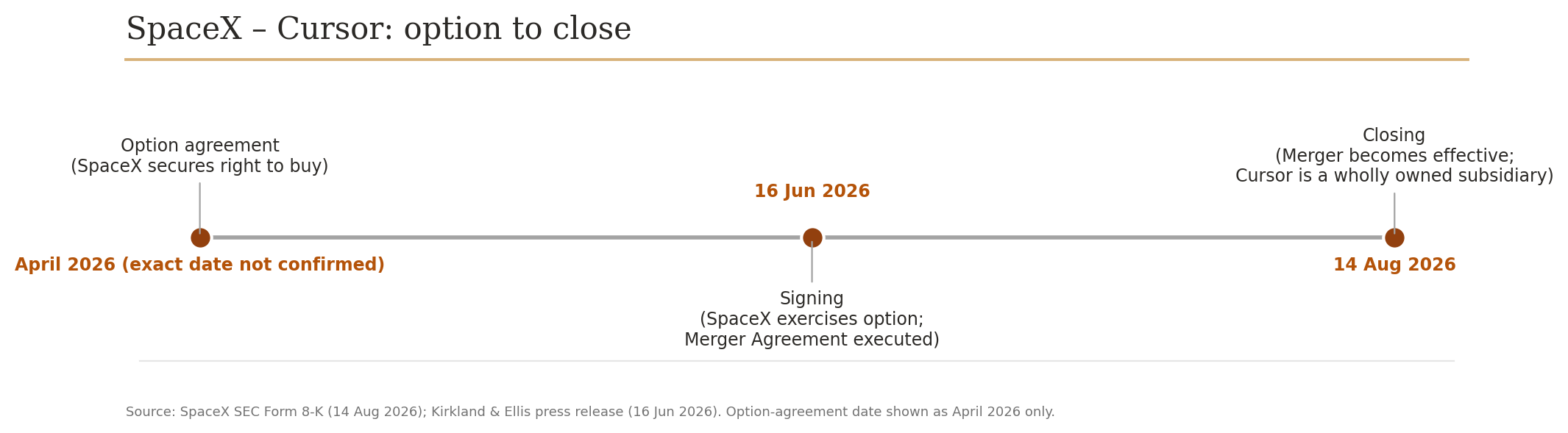
The deal is an all-stock merger (an acquisition where the seller's shareholders receive shares in the buyer instead of cash). A SpaceX merger subsidiary, X67 Inc., merged into Cursor, with Cursor surviving as a wholly owned SpaceX subsidiary. Per SpaceX's 8-K (a current report US public companies file with the SEC to disclose specified material corporate events), Cursor common and preferred shares (a class of shares carrying contractual rights or preferences over common shares, commonly held by venture investors) converted into approximately 389,289,254 shares of SpaceX Class A common stock (the basic form of company equity, generally carrying economic and voting rights).
This was based on the $60bn implied equity value and a 7-trading-day volume-weighted average SpaceX share price, with vested RSUs (a restricted stock unit for which the employee has already satisfied the applicable vesting requirements) converted similarly and unvested RSUs (an RSU whose employee has not yet satisfied the conditions necessary to own the underlying shares outright) assumed and converted into SpaceX equivalents. The share issuance relied on the Section 4(a)(2) private-placement exemption from SEC registration, which is a Securities Act exemption for transactions by an issuer that do not involve a public offering.
No cash or debt financing at all. 100% stock consideration which preserved SpaceX's cash but dilutes existing SpaceX shareholders. No lenders or financing law firms are involved for this reason.
Kirkland & Ellis LLP advised Cursor and Gibson Dunn advised SpaceX.
At $60bn, this is reportedly the largest venture-backed company sale ever. It is a strong structuring case for three reasons. Firstly, the difference between signing and closing the deal was two months due to regulatory clearance. Secondly, the case shows how all-stock mega-deals structured to avoid SEC registration, and thirdly it highlights the broader AI-infrastructure consolidation trend, with SpaceX following its earlier xAI acquisition. SpaceX is increasingly becoming much more than a rocket and satellite company. This is perhaps the most important strategic point. SpaceX acquired xAI in February 2026 and formally describes AI as one of its business segments, including AI compute infrastructure, Grok and X. Adding Cursor extends that strategy further into AI software and developer tools.
Update — 23 August 2026
After asking sources close to the deal, we find that the Cursor structure evolved after discussions with the SEC where it was confirmed that having an option on Cursor would not require publishing Cursor audited financials that were not going to be available in time for the desired launch of the IPO. This means that the option structure allowed SpaceX to proceed with its IPO on schedule without waiting for Cursor’s audited financials.
Update — 30 August 2026
On 29 August 2026, OpenAI announced it will cut off Cursor's access to its AI models on 12 November 2026, ending the partnership entirely rather than continuing to license its technology through the coding tool. OpenAI's stated reason is unusually blunt for a corporate announcement. It said it "cannot be confident that SpaceX will use our technology within our terms of service, based on our experience with Elon Musk's companies violating contracts." Cursor's CEO said OpenAI's models account for roughly 5% of Cursor's user traffic, and that the two companies are discussing the decision, but as of now the cutoff stands.
A change-of-control clause doesn't have to exist in a formal contract for a deal to trigger a counterparty walking away. Sometimes a buyer's reputation alone is enough to end a commercial relationship. For Cursor's users, it means one of several underlying AI models they could choose from will disappear in November, a direct product consequence of who now owns the company. For law students, it's a useful real example of counterparty risk and reputational spillover following a change of ownership, even without any breach having occurred.